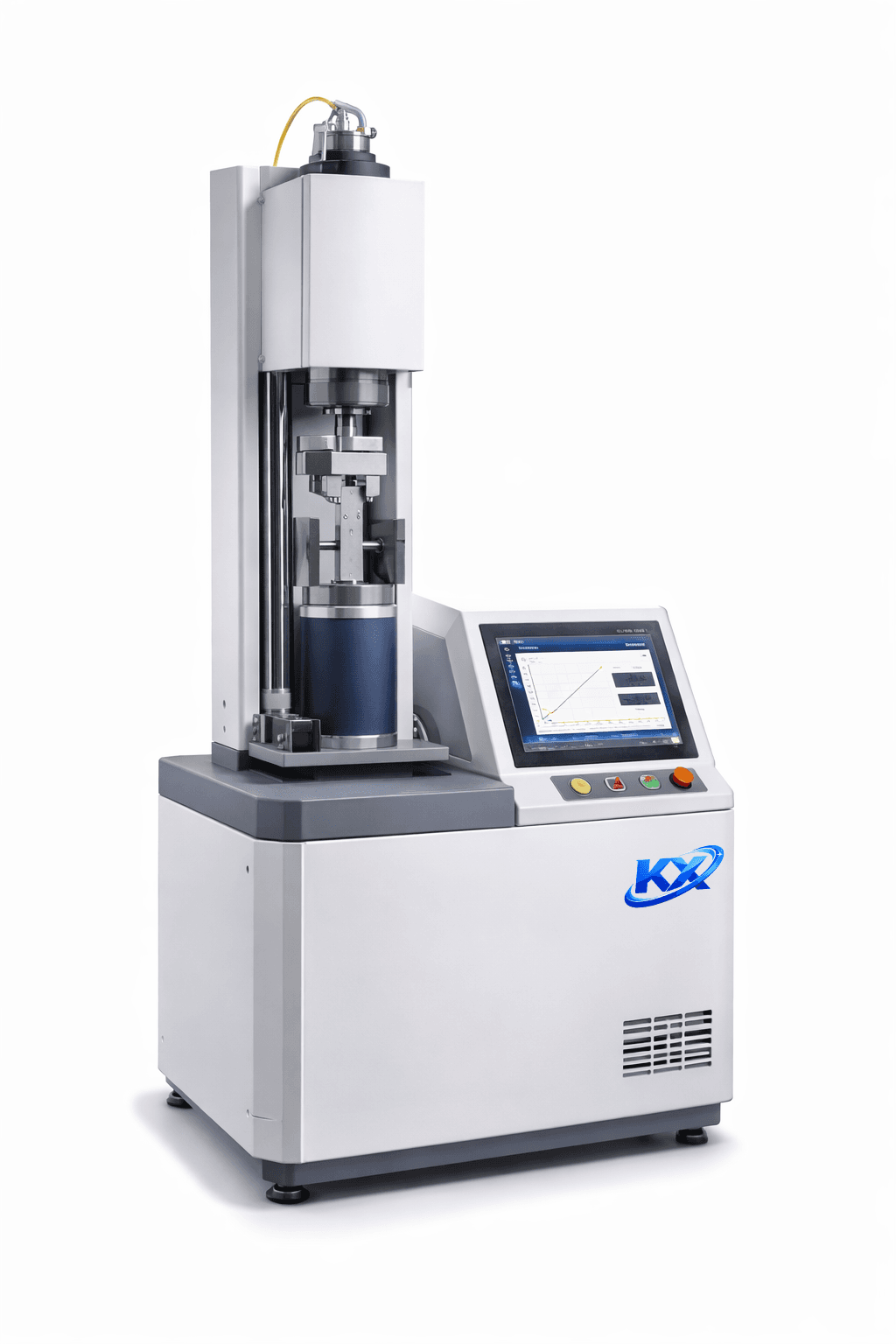
DMA (Dynamic Mechanical Analyzer)
Dynamic Mechanical Analyzer (DMA)
The Dynamic Mechanical Analyzer (DMA) is an advanced analytical instrument designed to evaluate the viscoelastic properties of materials as a function of temperature, time, frequency, and applied stress or strain. It provides detailed insight into the mechanical behavior and structural transitions of materials under dynamic loading conditions.
The system operates by applying a controlled oscillatory force or deformation to a sample and measuring its response, enabling precise determination of parameters such as storage modulus (E’), loss modulus (E’’), and damping factor (tan δ). This allows comprehensive characterization of material stiffness, energy dissipation, and phase transitions.
Designed for versatility, the DMA supports multiple deformation modes including tension, compression, bending, and shear, accommodating a wide variety of sample types such as polymers, elastomers, composites, films, fibers, and biomaterials. It enables evaluation of key thermal and mechanical properties including glass transition temperature (Tg), viscoelastic behavior, creep, stress relaxation, and dynamic response.
The instrument is widely used across industries including polymers, rubber, pharmaceuticals, automotive, aerospace, electronics, and academic research. It supports applications such as material development, quality control, failure analysis, and performance optimization.
Equipped with advanced control and data acquisition software, the system provides real-time monitoring, precise test control, and comprehensive data analysis with automated reporting. Its modular and adaptable design allows integration of various fixtures, environmental controls, and accessories to meet evolving testing requirements.
Overall, the Dynamic Mechanical Analyzer offers a robust, sensitive, and scalable solution for viscoelastic characterization, delivering high accuracy, repeatability, and reliability across a wide range of laboratory and industrial applications.
Capabilities
Key Features
Technical Data
Specifications
| Parameter | Value |
|---|---|
| Instrument Type | Dynamic Mechanical Analyzer (DMA) |
| Principle | Measurement of viscoelastic properties by applying controlled dynamic force or displacement as a function of temperature, frequency, and time |
| *Temperature System* | >>> |
| Temperature Range | Sub-ambient (with suitable cooling) to 500°C or higher |
| Temperature Accuracy | ±1°C or better |
| Temperature Precision | ±0.1°C or better |
| Heating Rate | Programmable, suitable for dynamic and ramp testing |
| Cooling System | Liquid nitrogen / mechanical cooling or equivalent (optional) |
| Temperature Control | High stability with uniform temperature distribution |
| *Force & Displacement System* | >>> |
| Force Range | Wide range suitable for soft to rigid materials |
| Force Resolution | High sensitivity for low-force measurements |
| Displacement Resolution | High resolution for precise deformation analysis |
| Control Modes | Force-controlled and/or displacement-controlled operation |
| *Frequency & Dynamic Measurement* | >>> |
| Frequency Range | Wide range (e.g., 0.01 Hz to 100 Hz or wider) |
| Dynamic Modes | Sinusoidal oscillation with precise control |
| Capability to measure: | Storage Modulus (E’), Loss Modulus (E’’), Damping Factor (tan δ) |
| *Measurement Modes* | >>> |
| Temperature Sweep | - |
| Frequency Sweep | - |
| Time Sweep | - |
| Creep | - |
| Stress Relaxation | - |
| Multi-frequency and multi-strain testing | (if applicable) |
| *Deformation Modes / Fixtures* | >>> |
| Tension | - |
| Compression | - |
| Single Cantilever | - |
| Dual Cantilever | - |
| Three-Point Bending | - |
| Shear (if applicable) | - |
| Compatibility with interchangeable fixtures and clamps | - |
| *Sample Handling* | >>> |
| Sample Types | Films, fibers, elastomers, rigid polymers, composites, and other materials |
| Sample Dimensions | Suitable for a wide range of sample sizes and geometries |
| Easy sample mounting and alignment | - |
| *Data Acquisition & Software* | >>> |
| Advanced software for: | --- |
| Real-time data acquisition and control | - |
| Modulus and damping analysis | - |
| Tg and transition detection | - |
| Creep and relaxation analysis | - |
| Method programming and storage | - |
| Automated report generation | - |
| Data export in standard formats | Excel, PDF, etc. |
| Compatibility with standard operating systems | - |
| *Performance & Reliability* | >>> |
| High repeatability and reproducibility | - |
| Stable baseline with low noise | - |
| Suitable for long-duration and continuous testing | - |
| *Utilities & Requirements* | >>> |
| Power Supply | Standard laboratory power (e.g., 220–240 V, 50 Hz or equivalent) |
| Gas Supply | Optional inert gas purge (if applicable) |
| Environmental Conditions | Standard laboratory conditions |
| *Safety & Compliance* | >>> |
| Built-in safety features including over-temperature protection | - |
| *System Configuration* | >>> |
| Complete system including: | DMA main unit, Furnace and temperature control system, Standard fixtures/clamps, Control and analysis software, Computer system (if required), Necessary accessories and consumables |
Inquiry
Interested in the
DMA (Dynamic Mechanical Analyzer)?
Fill out the form and our product specialists will respond with pricing, lead times, and configuration options within one business day.